Private Journeys · Western China
Travel Tips for Foreigners Visiting Xinjiang, China
You just bring your sense of adventure. Leave the rest to us.
One-line answer
Traveling to Xinjiang as a foreign visitor involves juggling visa paperwork, frontier permits, licensed hotel bookings, regulation-compliant route planning, and so much more
Essential Documents and Visas
Basic Requirements
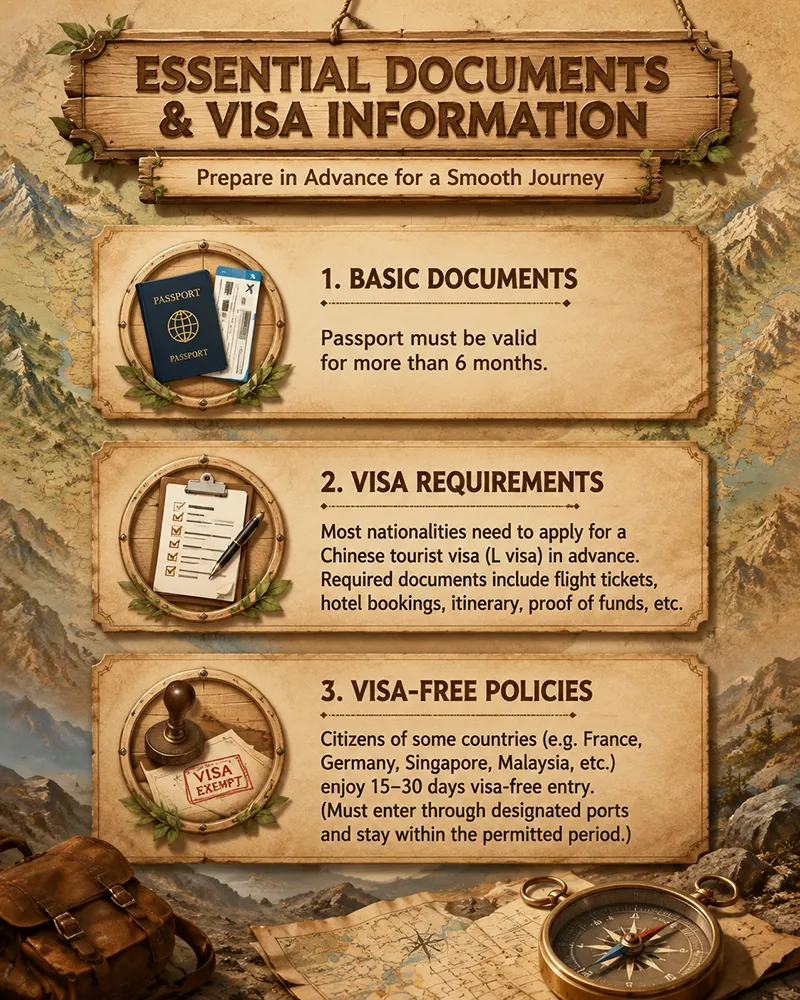
Your passport must have at least 6 months of remaining validity. Most travelers will need to apply for an L-type tourist visa in advance, with supporting documents including round-trip flight tickets, hotel booking confirmations, a detailed itinerary, and proof of financial means.
Thanks to China's steadily expanding visa-free policy, citizens of dozens of countries — including Singapore, Malaysia, Thailand, Australia, the United States, the United Kingdom, France, Germany, Italy, Spain and the Netherlands — can now enter mainland China visa-free for tourism stays of up to 30 days. The list is adjusted periodically, so confirm the current policy for your passport before booking.
Frontier Permits
Travel to border areas such as Tashkurgan, Baihaba, and Khunjerab requires a frontier permit processed in advance. Since April 15, 2026, border passes are fully electronic: Chinese citizens can apply online through the 12367 app, while foreign visitors apply in person (free of charge) at the exit-entry administration offices in Urumqi or Kashgar — or far more conveniently, have a licensed travel agency submit the application on their behalf at least 7 days prior. The Khunjerab Pass border gate is not open to ordinary foreign tourists — please do not attempt to visit on your own.
Helpful Tips
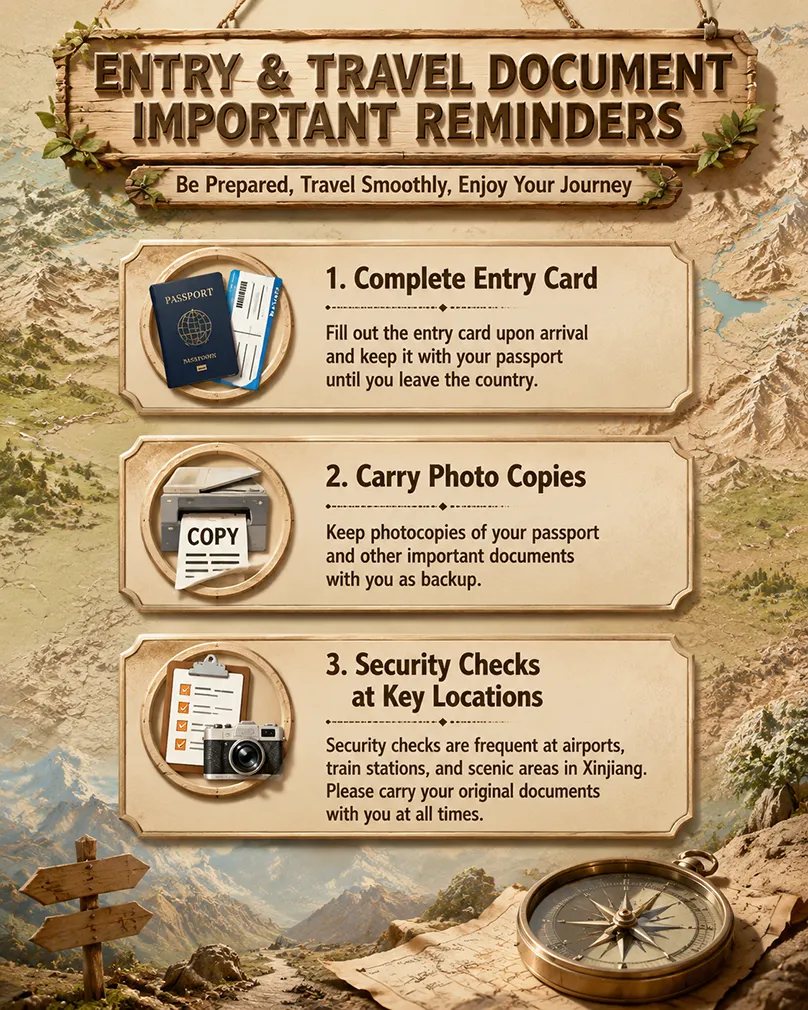
Keep your entry card and boarding passes safe at all times. Carry photocopies of your passport wherever you go. Security checks are common throughout Xinjiang, and you may be asked to present your original documents at any time.
Accommodation Registration
Foreign visitors may only stay at hotels licensed to accommodate international guests — generally rated three stars and above. Most guesthouses and B&Bs are not authorized to host foreign nationals, so always confirm before booking.
Temporary residence registration must be completed within 24 hours of check-in. Licensed hotel front desks will handle this for you. Never stay at unlicensed accommodations; violations can result in fines at best, and disruption of your entire trip at worst.
Transportation
Getting to Xinjiang
For international flights, we recommend flying into Beijing, Shanghai, or Guangzhou first, then taking a connecting flight to Urumqi. Train tickets must be purchased in person at station counters using your passport; most routes do not support online booking for foreign travelers.
Getting Around Xinjiang
We strongly recommend arranging a private charter or a small custom tour through a travel agency. Choose a licensed vehicle with 7 seats or more for the most worry-free experience. If you plan to drive yourself, an international driving permit along with a notarized translation is required; note that self-driving is not permitted on most border-adjacent road sections. Public transport coverage is limited, so do not rely on buses for remote scenic areas.
Restricted Zones
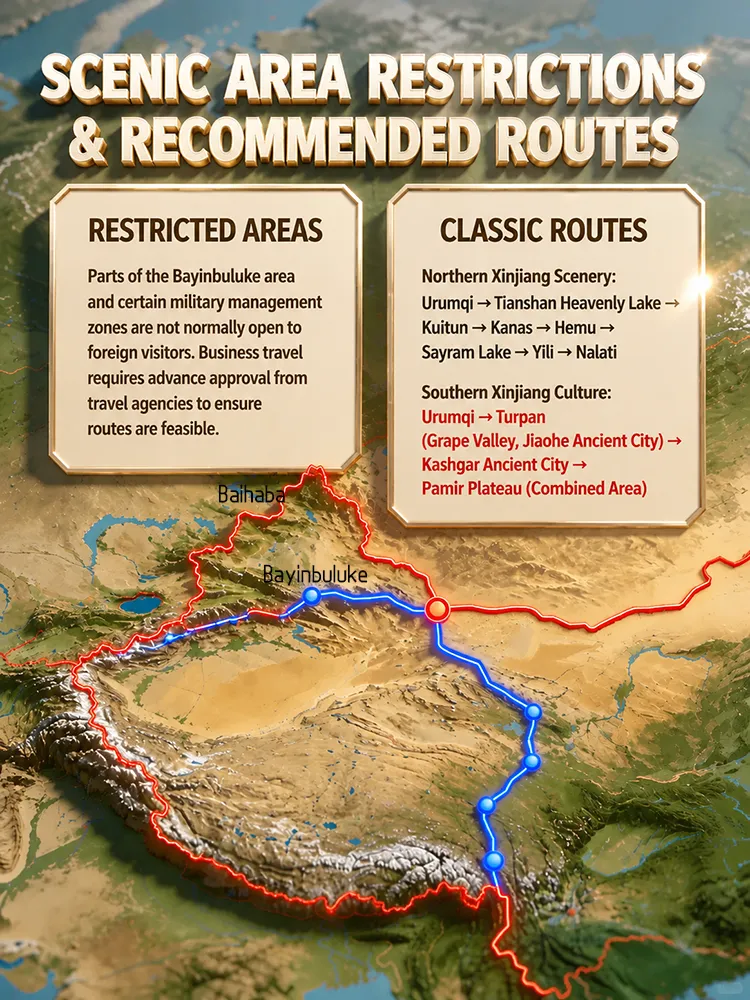
Certain areas within Bayanbulak, specific sections of Baihaba, and all military zones are not open to ordinary foreign visitors. Always have your travel agency verify the legality of your route before departure to avoid unnecessary trouble.
Cultural Etiquette and Safety Tips
Respecting Local Customs
When entering a mosque, dress modestly, remove your shoes, and maintain a quiet demeanor. Do not casually photograph local residents, especially in religious settings. Pork is strictly forbidden and alcohol is not permitted in halal restaurants.
Climate and Packing
Temperature differences between day and night in Xinjiang can reach 15 to 20 degrees Celsius. Be sure to pack ample sun protection, a windproof jacket, and moisturizing skincare products.
Safety
Xinjiang has excellent public security. However, we still advise against venturing into remote areas alone late at night. Keep your documents and valuables secure at all times.
Best Time to Visit: A Season-by-Season Overview
Spring (April–May): apricot blossoms bloom across the Ili Valley, crowds are thin, and flights and hotels are cheaper — though high-altitude areas in the north may still hold patches of snow.
Summer (June–August): the grasslands are at their greenest and the Duku Highway opens around June 1 — the classic peak season. July–August brings the largest crowds and highest hotel prices, so book well in advance.
Autumn (September–October): Kanas and Hemu turn into an oil painting, the weather is crisp, and the Duku Highway usually stays open until early October. It is photographers' favourite season and a great choice for first-time visitors.
Winter (November–March): Kanas and Hemu become a snowy fairy tale and Altay offers skiing; the Duku Highway is closed for the season, while Kashgar and the Pamirs have their own winter charm.
How Much Does a Xinjiang Trip Cost?
Your budget is shaped by three main factors: season (July–August premium rates), group size (the larger the group, the lower the per-person cost), and standard (hotel tier, vehicle type, and whether internal flights are included).
Private custom tours are usually quoted per person per day, bundling an RV or private van with a driver, licensed foreigner-friendly hotels, tickets, and transport. Internal flights — such as Urumqi–Kanas round trips — are a separate major cost.
The easiest way to plan: tell us your travel month, group size and preferred standard, and we will prepare a detailed quote that fits your budget.
Getting Around: Flight, Train or Private Car?
Flights: Urumqi is Xinjiang's aviation hub. Urumqi–Kanas (Burqin) takes about 1.5 hours and Urumqi–Kashgar about 2 hours — internal flights can compress what would be two or three days of driving into half a day.
High-speed rail: high-speed and express trains link Urumqi with Turpan and Yining — comfortable and punctual, a good fit for some legs of the journey.
Private car / RV: the most flexible option and the mainstream way to explore Xinjiang in depth — your driver knows the roads, attractions, speed limits and parking, so you simply enjoy the ride.
Our recommended pattern: fly or take the train for long distances, then explore locally by private car — that is exactly how most of our routes are designed, saving time without rushing.
Is Xinjiang Safe for Tourists?
Q: Is Xinjiang safe for tourists? A: Yes. Xinjiang has one of the most robust public security systems in China: routine security checks at airports, railway stations, scenic areas and major intersections, dense police presence, and a very low crime rate. The region welcomes tens of millions of domestic and international visitors every year.
Q: Are foreigners welcome? A: Absolutely. Xinjiang is actively developing inbound tourism — the electronic border permit introduced in April 2026 is one example of visitor-friendly policy. As long as you respect local religious and cultural customs (no pork in halal restaurants, modest dress in mosques), you will meet plenty of warm and welcoming locals.
Q: Are there many security checks? A: Quite a few, but they are fast and routine. Carry your original passport and you will pass through smoothly. Never photograph checkpoints or military facilities.
Q: Can I travel independently? A: Independent travel works fine in major cities. Border areas like Tashkurgan and Baihaba require permits, and some zones only accept group tours — which is why most foreign visitors arrange their routes through a licensed agency for a smooth, compliant trip.
Leave It All to Yuefeixiang International Travel
Traveling to Xinjiang as a foreign visitor involves juggling visa paperwork, frontier permits, licensed hotel bookings, regulation-compliant route planning, and so much more — one small oversight can throw your entire trip off track. But when you come to us — Yuefeixiang International Travel — we handle everything for you. With extensive experience in hosting international guests and deep knowledge of every regulation and requirement, we take care of it all, from document processing to private charters, from hotel arrangements to tailor-made itineraries. You just bring your sense of adventure. Leave the rest to us.
Want to turn this guide into your own route?
Send us your month, group size and preferred pacing. We can turn this guide into a route that fits your real trip.